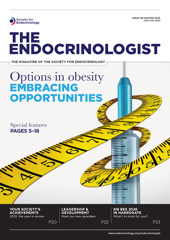
Welcome to this supersize issue, which is rather fitting, considering it’s all about obesity – one of the largest clinical problems facing us in the modern era. The good news is that there have been huge leaps in our understanding and treatments over the last few years.
The glucagon-like peptide-1 receptor agonist drugs, such as Ozempic/Mounjaro, have been a huge success story. However, these are relatively new to the market, so it is important that we understand any unexpected side effects. This topic is discussed by Jessica Wright and Nicoletta Charolidi from the MHRA, who highlight the Yellow Card scheme and Biobank to investigate genetic-based adverse responses to the drugs. It’s a must-read for all healthcare professionals.
Also, as Giles Yeo said when I interviewed him, ‘We mustn’t blow the opportunity. We need to minimise risk and find other approaches to target the brain to reduce food intake.’ So we can’t stop now, we need to continue researching, including studies of unexpected models such as the ‘hungry Labrador’, which are discussed by Enoch Alex and Eleanor Raffan.
The age of bariatric surgery has not passed. It is still a very useful tool in the fight against obesity, for example in cardiovascular disease, as highlighted by Safwaan Adam and Akheel A Syed. The management of patients after surgery also remains important, and we feature two articles on this. One discussing the current thinking around same-day discharge, the other on supporting women with pregnancy after weight-loss surgery.
I hope you enjoy this issue, which addresses the science and clinical aspects of obesity and, most importantly, shows you the exciting areas that endocrinology covers. There will no doubt be plenty more to absorb on this in the talks and posters at SfE BES 2026, for which registration is open!
KATE LINES