Obesity is a global health challenge for both humans and our canine companions. In the UK, over 60% of adult humans and a similar proportion of pet dogs are overweight or obese.1 Living alongside us in our homes, dogs share an ‘obesogenic’ environment, characterised by ready access to energy-dense food and increasingly sedentary lifestyles.1
For decades, researchers have relied on rodent models to unpick the complex biology of energy balance. Whilst invaluable, these models have their limitations, particularly as key metabolic pathways in rodents can have important differences compared with human physiology.1–3 Given these limitations, dogs may become a powerful ally in this field of research.
THE CANINE ADVANTAGE IN GENETIC DISCOVERY
Studying the genetics of common obesity in humans is notoriously complex, with thousands of genetic variants, each contributing incrementally to an individual’s susceptibility to weight gain.1 This makes moving from a statistical association to biological insight a significant task.4
'The Labrador provides a naturally occurring model to investigate the specific roles of these peptides, an opportunity not readily available elsewhere.'
Dogs, however, offer a unique genetic architecture. Centuries of selective breeding have created distinct breeds, each representing a closed genetic population with long stretches of linkage disequilibrium.1,5 This unique population structure makes it more straightforward to map genes for complex traits such as obesity.5,6 In essence, the genetic signals are stronger and easier to find.
A CASE STUDY: THE HUNGRY LABRADOR
A compelling example of this canine advantage can be seen with Labrador retriever, a breed famously predisposed to obesity. Raffan et al. identified a 14-bp deletion in the pro-opiomelanocortin (POMC) gene,3 which is carried by approximately a quarter of all Labradors. This gene is a cornerstone of the leptin–melanocortin pathway, which is the master regulator of food intake and energy balance in the brain.3,7
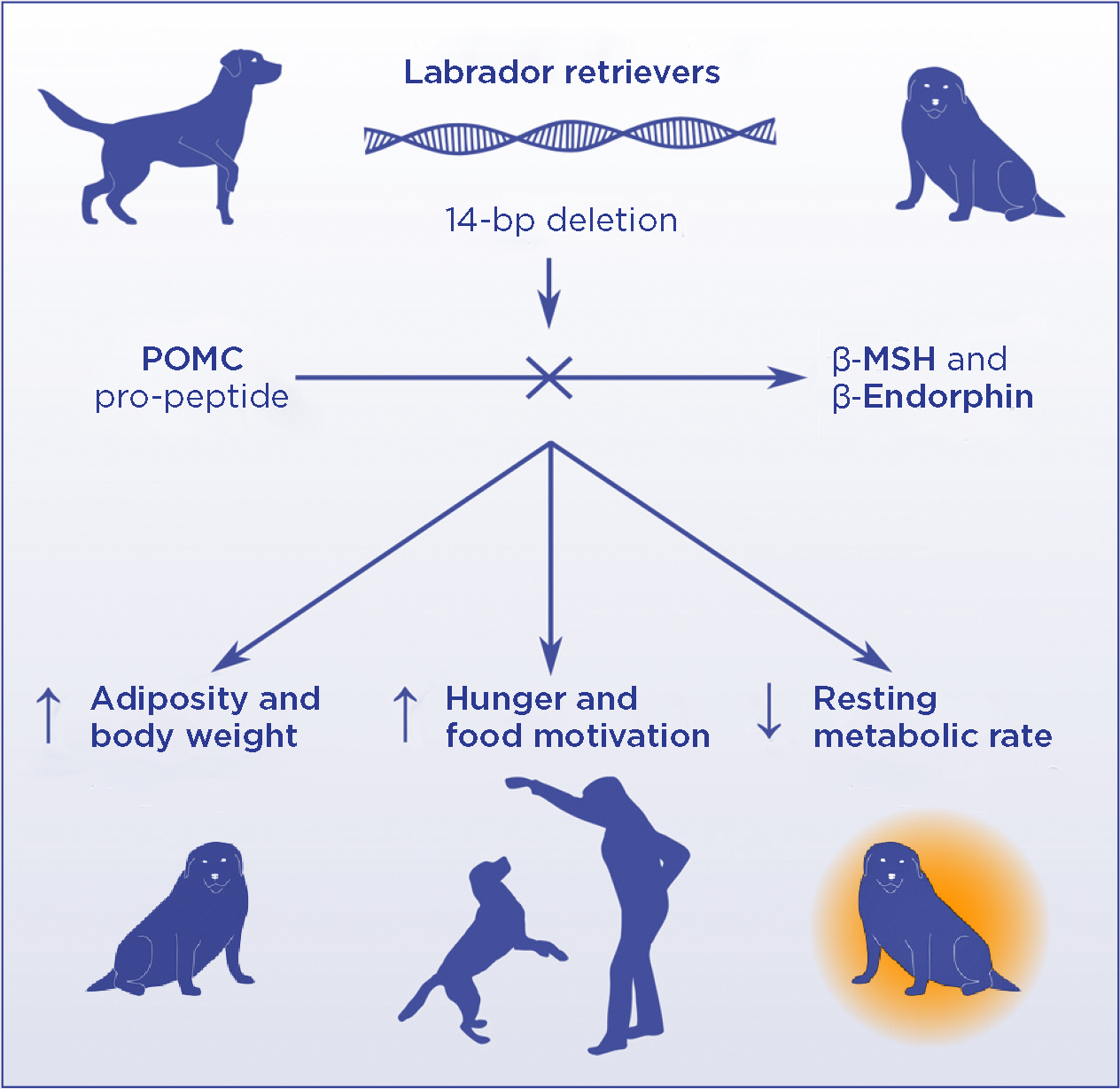
The Labrador POMC mutation doesn’t disrupt the entire gene. Instead, it specifically prevents the production of two neuroactive peptides derived from cleavage of the gene product: β-melanocyte-stimulating hormone (β-MSH) and β-endorphin, while leaving production of a third peptide, α-MSH, intact.3 This is an important detail, because rodent models, the workhorse of metabolic research, naturally lack the cleavage site to produce β-MSH.2,3 They rely solely on α-MSH for melanocortin signalling. Humans, like dogs, produce both, but patients with variants affecting only β-MSH were hard to find and not available for systematic study. The Labrador, therefore, provides a naturally occurring model to investigate the specific roles of these peptides, an opportunity not readily available elsewhere.2,3
A 14-bp deletion in the POMC gene in Labrador retrievers prevents the production of β-MSH and β-endorphin. This genetic variant is associated with increased adiposity, higher food motivation and decreased resting metabolic rate. POMC, pro-opiomelanocortin; MSH, melanocyte-stimulating hormone. Reproduced with adaptation under CC BY 4.0 licence from Raffan et al.3 ©The Authors 2016
So, what happens when these peptides are missing? In a follow-on study, our group showed that affected dogs are not just hungrier, displaying greater motivational salience for food in a ‘sausage in a box test’, but they also have a significantly lower resting metabolic rate, burning approximately 25% fewer calories at rest than dogs without the mutation (Figure).2 This ‘double whammy’ of increased hunger and reduced energy expenditure powerfully explains their predisposition to weight gain.2 This finding implicates β-MSH and/or β-endorphin as critical in regulating energy expenditure, a role that was previously obscured by the limitations of rodent models. In a pleasing corroboration of our findings, a large biobank-scale project recently identified a POMC mutation in Northern Europeans that increases obesity by disrupting β-MSH production in people.8
FROM CANINE GWAS TO HUMAN BIOLOGY
The story doesn’t end with single-gene discoveries. The tractability of the dog genome now allows for successful genome-wide association studies (GWAS). In a recent study, our group conducted the first successful canine GWAS for a canine measure of adiposity, body condition score, identifying several new obesity-associated loci.9
The top hit was within a gene called DENND1B (DENN domain-containing 1B). Each copy of the risk allele was associated with approximately 8% greater body fat.9 Taking an innovative cross-species approach, this gene was further investigated in human obesity datasets and it was found that variants in the human DENND1B gene are also associated with both common and rare forms of obesity.9
Molecular studies revealed that DENND1B plays a previously unsuspected role in regulating the trafficking of the melanocortin 4 receptor, a critical controller of energy homeostasis.9 The work validated a powerful new paradigm: using the canine model not just to confirm known pathways, but to discover entirely new obesity genes and mechanisms that are directly relevant to human health.
MAN’S BEST FRIEND IN RESEARCH
Our pet dogs are more than just companions; they can be valuable, spontaneously occurring models of complex human disease. By studying their unique genetics in the context of our shared environment, we can accelerate the pace of discovery. The insights gained from the hungry Labrador retrievers have already refined our understanding of the melanocortin pathway.2,3 As we continue to study dogs, there is potential to uncover new therapeutic avenues that could one day benefit both ends of the leash.
ENOCH ALEX
PhD Student, Department of Physiology, Development and Neuroscience, Corpus Christi College, University of Cambridge
ELEANOR RAFFAN
University Associate Professor in Systems Physiology, Department of Physiology, Development and Neuroscience, and Affiliated Principal Investigator, Institute of Metabolic Science, University of Cambridge
REFERENCES
1. Wallis N & Raffan E 2020 Genes https://doi.org/10.3390/genes11111378.
2. Dittmann MT et al. 2024 Science Advances https://doi.org/10.1126/sciadv.adj3823.
3. Raffan E et al. 2016 Cell Metabolism https://doi.org/10.1016/j.cmet.2016.04.012.
4. Locke AE et al. 2015 Nature https://doi.org/10.1038/nature14177.
5. Sutter NB & Ostrander EA 2004 Nature Reviews Genetics https://doi.org/10.1038/nrg1492.
6. Karlsson EK et al. 2007 Nature Genetics https://doi.org/10.1038/ng.2007.10.
7. Yeo GSH & Heisler LK 2012 Nature Neuroscience https://doi.org/10.1038/nn.3211.
8. Abner E et al. 2025 Nature Communications https://www.nature.com/articles/s41467-025-64006-9.
9. Wallis NJ et al. 2025 Science https://doi.org/10.1126/science.ads2145.