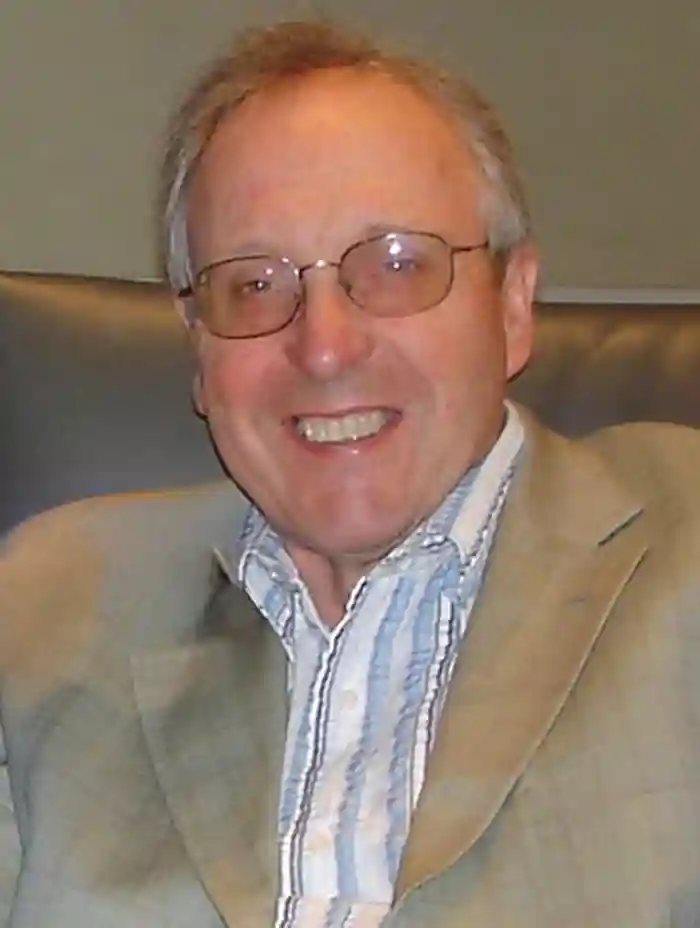
David Ramsden, Emeritus Professor at the University of Birmingham, passed away in 2024, just a year after the Department of Metabolism and Systems Science held a festschrift in his honour. David was one of the great unheralded catalysts of modern UK endocrinology, particularly thyroid hormone research. This article belatedly pays tribute to his achievements as a research scientist and his role in the evolution of endocrinology at Birmingham over the last 50 years.
David joined the then Department of Medicine at Birmingham in 1973. He worked first as a Lecturer, then as Senior Lecturer, and Reader, until 2006. He was Honorary Reader in medicine until 2016, when he became Honorary Professor.
David had already worked with Raymond ‘Bill’ Hoffenberg at Northwick Park Hospital, Harrow, before he followed Hoffenberg in joining the University of Birmingham in 1973. Their first collaborative thyroid paper was published a year later.1 In 1984, David published his final collaborative paper with Bill2 but, by then, the team had expanded to include two other future stars of UK endocrinology: Jayne Franklyn and Mike Sheppard. David played a major role in mentoring both Jayne and Mike, and from the mid-1980s to mid-1990s they co-published more than 30 thyroid hormone-related papers, being joined by some other prominent Birmingham researchers, such as Kevin Docherty and Joe Bradwell. Notable publications from this time included David’s 1993 paper on the human thyroxine-binding globulin gene.3
From the mid-1990s onwards, David’s research shifted away from specific thyroid hormone studies to include an interest in plasticisers and endocrine disruptors,4 as well as biotransformation and sulfation pathways.5 In 2017, long after his retirement, David participated in an international conference on sulfation pathways, held in Birmingham, and registered as a Student for this event – equivalent to the discount for the Society’s Senior Members, which we had forgotten to implement!
“Life is what it is, and one must enjoy every moment, no matter what the situation. That does not mean one is always laughing, but even the saddest moments in one’s life have their wells of contentment.” David Ramsden, 2023
These later studies led to David’s great research passion in the final phase of his career, which was Parkinson’s disease. Working with Rosemary Waring, Adrian Williams and Richard Parsons at Birmingham, David published over 30 papers on a wide range of mechanisms linked to Parkinson’s disease, typified by a 1999 review.6 This new avenue of research also introduced David to a fresh community of collaborators, notably Shu-Leong Ho from Hong Kong, who was initially a Clinical Research Fellow in neurology, recruited by Adrian Williams.
In 2011, David was appointed Royal Society Kan Tong Po Visiting Professor at the University of Hong Kong. Long before the advent of Zoom, he would often be heard to say, ‘I have a Skype appointment with Hong Kong’, in response to requests for meetings. David’s very fruitful collaboration with Leong and his team resulted in more than 40 original research papers, book chapters and reviews on topics related to Parkinson’s disease. They even filed an international patent. Their first jointly co-authored paper was on monoamine oxidase B.7 Soon they were joined by Philip Ho.8 David’s high reputation abroad and his commitment to supporting and mentoring international students was also reflected by his research group’s nickname, ‘The United Nations’.
Until the very last days of his life, David remained incredibly active, unwavering in his research effort, features of a truly respected and committed scientist and mentor. Indeed, one of David’s papers was published posthumously.9 It had a special mention of David in the acknowledgements section:
‘We would like to express our deepest gratitude to the late Professor David Boyer Ramsden for his invaluable guidance and mentorship that laid the foundation for our research. David was an extraordinary scientist and a true visionary, whose passion for knowledge and scientific excellence inspired us all. Though no longer with us, David’s impact on our professional growth will forever be remembered and cherished.’
David was more than the sum of many collaborations and his research expertise. He was also a great mentor and champion of teaching, who continued his commitment to the University of Birmingham in retirement through his volunteer activities for student recruitment and admission. This was all the more impressive as David’s mobility was increasingly limited in his final years, after he was diagnosed with progressive supranuclear palsy.
The many people at Birmingham and across the globe who worked with David would all agree that he was one of the last of a dying breed of academics who ‘did not suffer fools gladly’. David looked at the world from different angles. We will miss his frank views on academia, but also his achievements in the field of endocrinology and his incredible generosity to his colleagues and students. We send our belated commiserations to his wife Pamela and children Aidan, Miles and Katrina.
JONATHAN WOLF MUELLER, PHILIP WING-LOK HO, SHU-LEONG HO and MARTIN HEWISON
REFERENCES
1. Ramsden DB et al. 1974 Biochemical Journal https://doi.org/10.1042/bj1430047.
2. Franklyn JA et al. 1984 Clinical Endocrinology https://doi.org/10.1111/j.1365-2265.1984.tb00100.x.
3. Akbari MT et al. 1993 Biochimica et Biophysica Acta https://doi.org/10.1016/0167-4781(93)90013-4.
4. Waring RH et al. 2012 International Journal of Andrology https://doi.org/10.1111/j.1365-2605.2012.01248.x.
5. Elekima OT et al. 2000 Liver https://doi.org/10.1034/j.1600-0676.2000.020001045.x.
6. Williams AC et al. 1999 Advances in Neurology PMID: 10410724.
7. Ho SL et al. 1995 Annals of Neurology https://doi.org/10.1002/ana.410370318.
8. Ho PW et al. 2005 Journal of Neuroscience Research https://doi.org/10.1002/jnr.20569.
9. Chang EE et al. 2024 Cell Communication & Signaling https://doi.org/10.1186/s12964-024-01844-y.