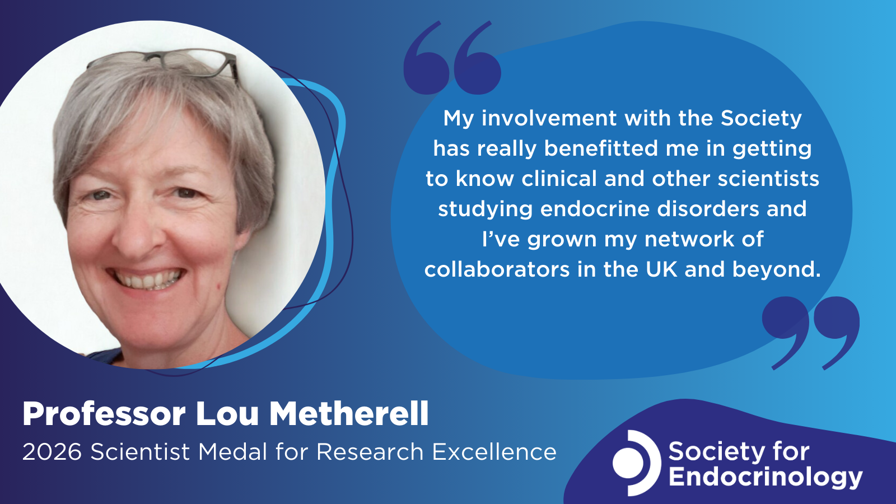
Congratulations to Professor Lou Metherell, winner of the 2026 Scientist Medal for Research Excellence. We had the pleasure of catching up with Professor Metherell to learn more about her incredible work and the impact the Society has had on her professional journey.
Lou obtained a BSc in Biology from the University of Manchester BSc in 1985. During her undergraduate studies she developed an interest in genetics which led her to undertake a postgraduate diploma in Human Genetics at the University of Aberdeen. After a brief period in industry, Professor Metherell returned to science and was awarded her PhD from the University of Greenwich in 1999. She joined the Centre for Endocrinology at William Harvey Research Institute, QMUL in 1998, where her research has focused on the genetics of endocrine disease, particularly disorders of adrenal insufficiency. Lou is currently a Professor of Endocrine Genetics and Head of Department for the Centre for Endocrinology, WHRI, Queen Mary University of London.
- What do you enjoy most about your work?
Definitely, the research side is most rewarding, gene hunting to get people a genetic diagnosis. With rare disease it can take a long time to get a diagnosis and individuals can feel very isolated, it’s great to be able to give someone a “handle” for their disorder. It’s intellectually satisfying as each case is a investigation, sometimes easy to solve when the individual has a mutation in a known gene, beyond that the fun really starts to find a novel cause and find out how the gene defect causes the phenotype.
- What are your biggest and/or most recent achievements?
I’m internationally renowned for deciphering the genetics of familial glucocorticoid deficiency, identifying 5 genes contributing to rare adrenal insufficiencies beyond Addison’s and CAH. Through the years I ‘ve curated one of the largest international cohorts of rare adrenal insufficiency cases (>400) with referrals from >40 countries. More information on this can be found online. We have published the largest UK and African cohorts (Buonocore et al. JES 2021; Musa et al. EJE 2025) reported to date. This has led to changes in clinical practice and molecular diagnosis with the recommendation of genetic testing for AI diagnostics in European and American clinical guidelines, and improved genetic analysis and information for patients who often have a diagnostic odyssey.
When I began this journey of discovery we were dealing with isolated gludocorticoid deficiency but latterly we are finding genes that cause syndromes where adrenal insufficiency is only part of the clinical picture. Most recently we’ve discovered that individuals with mutations in genes causing porphyria can be at risk of adrenal crisis and are working to get this recognised and individuals treated where necessary.
- What words of wisdom do you have for aspiring endocrinologists?
Build up a network of collaborators and work with people that you like, making sure you have time for social interactions. A strong team ensures adaptability and resilience, which you need in our line of work to regroup after any setbacks in research findings, funding, publications, etc. Believe in yourself and line up varied mentors throughout your career to help with different aspects as you progress.
- Why did you get involved with the Society, and why should other professionals working in endocrinology do the same?
My involvement with the Society has really benefitted me in getting to know clinical and other scientists studying endocrine disorders and I've grown my network of collaborators in the UK and beyond. It’s also a great place to hear about the latest research and techniques being applied to endocrine problems.
- Have you been to SfE BES before? If so, can you tell us about your experience of the event?
Yes, I have been to SfE BES meeting many times before, most recently attending the Joint Irish–UK meeting in 2024. Amongst the most memorable times would be the 24th Joint meeting in April 2005 where I gave my first oral presentation describing the finding of a novel gene for Familial Glucocorticoid Deficiency, MRAP. This, and an early career award in 2007 really helped shape the direction of my research into the genetics of adrenal insufficiency.
Each medallist and award winner brings a unique story of passion and dedication to the field. We are excited to be highlighting their efforts and look forward to showcasing more winners with you throughout the year. Their achievements will be formally recognised at our flagship event, the annual SfE BES Conference, where they will be presented with their awards in front of peers and leaders from across the endocrine community.
Book your place at SfE BES 2026 for the UK’s biggest celebration of endocrinology. Our annual conference brings together the brightest minds, the latest discoveries, and the most inspiring conversations in the field. Join us in Harrogate, from 2-4 March 2026, to celebrate the Society medallists and award winners successes, and connect and learn with our inspiring community.
Disclaimer: Pharmaceutical companies' sponsorship covers the exhibition space at SfE BES, with no influence over the agenda or arrangements. This excludes sponsored symposia sessions, where the programme is developed and speakers identified by the sponsor. https://bit.ly/434gEVB