Make sure you and your colleagues access all the support that is available to endocrine nurses through the Society for Endocrinology.
In the last 30 years, we have seen exponential growth in the Society for Endocrinology’s training and development portfolio for nursing. The 1990s kicked off many firsts for the Society’s nurse membership, with the formation of the Nurse Committee, Endocrine Nurse Training Course (which evolved into the Endocrine Nurse Update) and Nurses Sessions at the SfE BES conference.
The importance of training and developing endocrine nurses is highlighted in the GIRFT report, in particular the importance of attending Society for Endocrinology academic events.1
COMPETENCY FRAMEWORK FOR ADULT ENDOCRINE NURSING
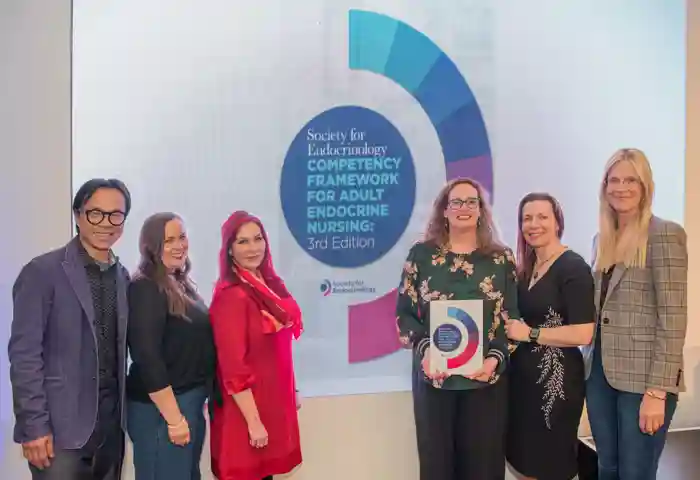
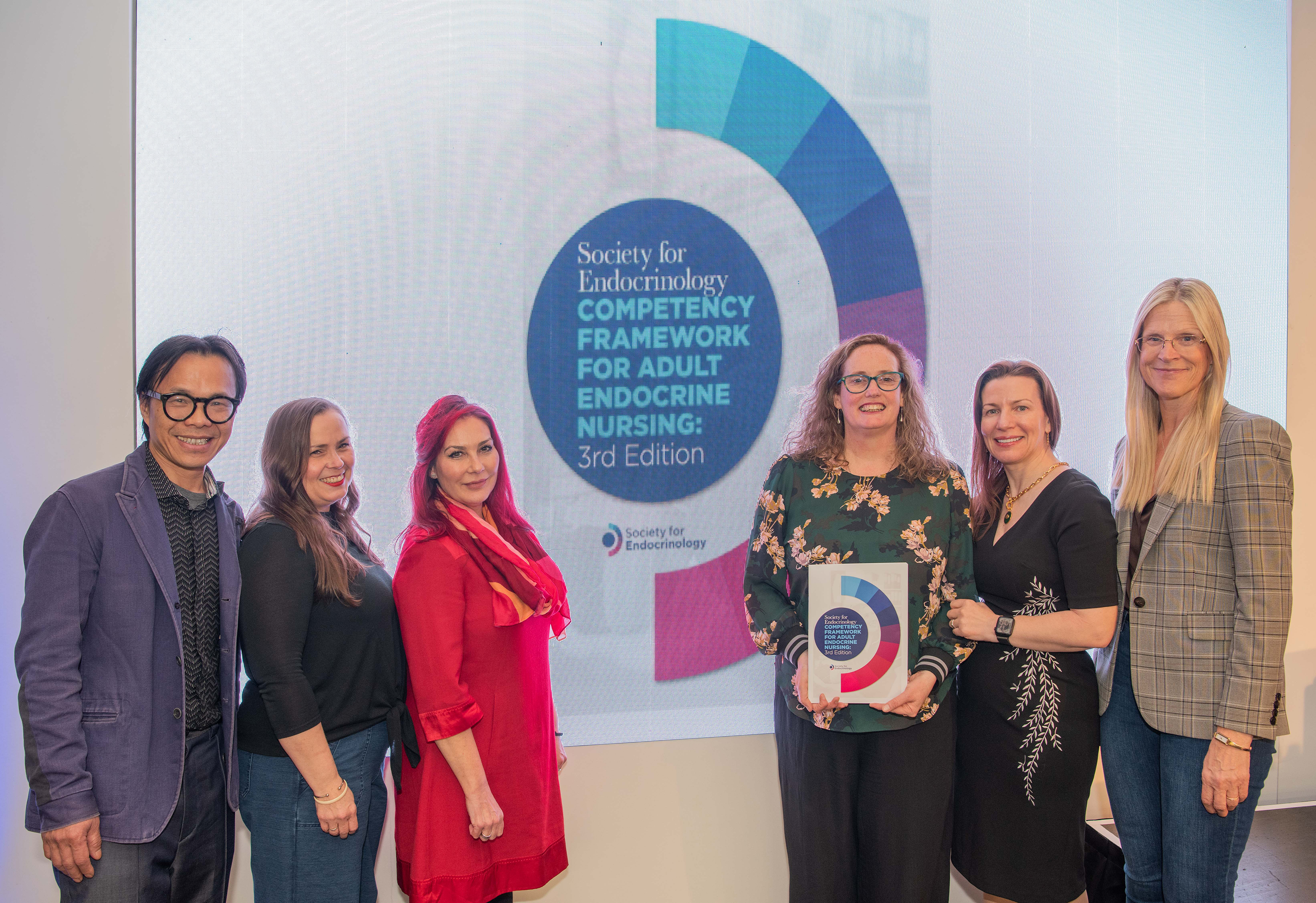
Working Group for the 3rd Edition of the CFAEN: L–R Phillip Yeoh, Kate Davies, Lisa Shepherd, Louise Breen, Sofia Llahana and Anne Marland.
The Society’s Nurse Committee has continued to push the nursing agenda forward and created a plethora of opportunities for endocrine nurses. One of the most significant and globally endorsed is the Society for Endocrinology Competency Framework for Adult Endocrine Nursing (CFAEN). This was launched in 2013, with the second edition in 2015, under the leadership of Endocrine Specialist Nurse Nikki Kieffer.
The current, third edition of the CFAEN has built on the legacy of our peers, evolving to include novice and advanced beginner competencies for nursing support workers, along with tools to demonstrate competence in practice (e.g. an evidence log). Eighteen clinical competencies have been added and updated to reflect current practice. Core clinical and safety competencies for endocrine nursing are highlighted, guiding priorities for learning and development for those new to endocrine nursing. Core nurse-led service competencies reflect the common nurse-led services.2 The addition of research, education, and leadership and management competencies has aligned the CFAEN with the four pillars of advanced clinical practice.3
ONLINE LEARNING PLATFORM
The Society for Endocrinology Online Learning Platform (OLP) has been available to the Society’s nursing membership since February 2025. This coincided with the launch of the third edition of the CFAEN, and it hosts the CFAEN’s online version. This version provides improved accessibility and efficiency for updating and the addition of new competencies, without the associated printing costs. Relevant resources for all competencies, including evidence logs, with examples of how to evidence practice, are welcome additions. Translation into multiple languages is planned for the CFAEN, giving this valuable resource a wider reach.
While the endocrine nursing community continues to grow, many members continue to work in isolation. The OLP offers mentorship as a mentor/mentee, with training and education to support mentorship. Mentors and mentees can message, arrange meetings, set goals and share files via the platform. The ‘My Groups’ function allows members to network and share expertise with the endocrine nursing community. The OLP Working Group is in place to review and update resources for the OLP.
If you are a Society member and have not yet signed up to the OLP, please do so.
OTHER TRAINING, DEVELOPMENT AND EDUCATIONAL OPPORTUNITIES
The Master’s level module in endocrine nursing was championed and developed in conjunction with Oxford Brookes University by Anne Marland, Consultant Endocrine Nurse. To date, 28 nurses have completed this Level 7 module (40 credits).
Patient support groups (PSGs) provide a wealth of information to support healthcare professionals and patients alike. The majority have a nursing representative who works closely with them. Engagement and familiarity with PSGs are essential to the endocrine nursing role. Many PSGs are affiliated to the Society.
You can find upcoming Society events online, including webinars and PSG-led online training. The Members’ Area of the Society website provides additional resources, such as access to oral presentations, policies and guidelines.
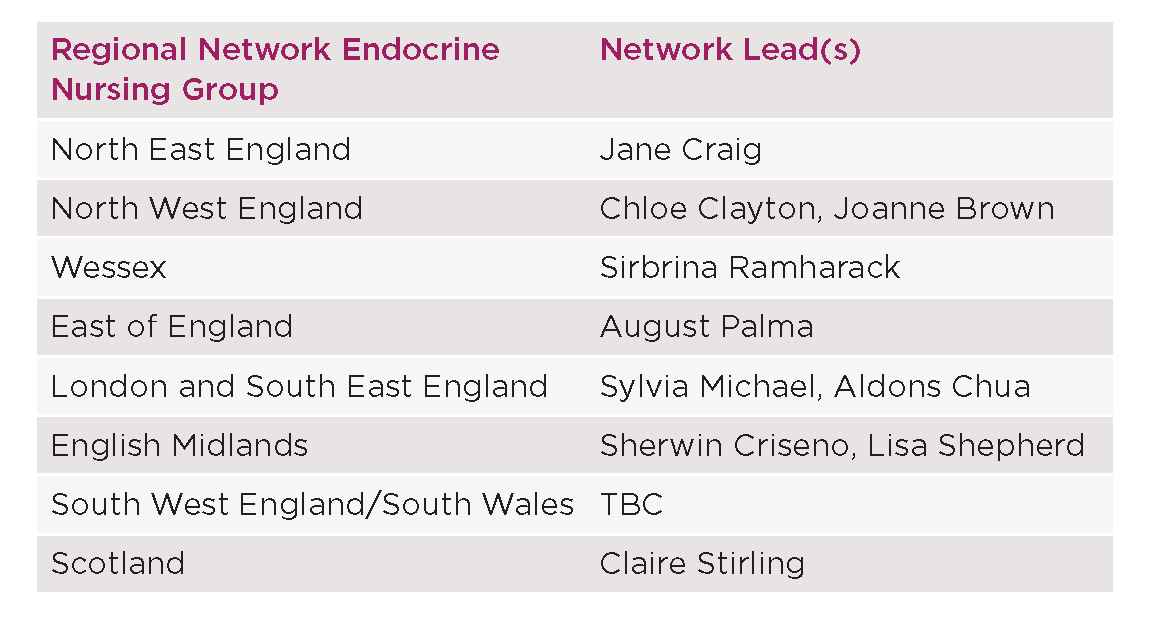
The Society for Endocrinology also supports Regional Network Endocrine Nursing Groups (see Table). There are currently eight in the UK. The Network Groups have been going from strength to strength, and meet virtually or face to face. The Nursing Support Workers Network was launched in 2025; we are working with our newest member group to shape their role in endocrinology. If you would like to sign up to any of these networks please email [email protected].
AWARDS AND GRANTS
The Society for Endocrinology offers a number of awards, grants and prizes. These include the Leadership and Development Awards Programme and the Nikki Kieffer Medal. You could also apply for a Society grant. These provide funding for numerous activities, including meeting attendance and research.
Accessing funding and study leave to attend relevant meetings remains a challenge. The OLP has relevant information on potential avenues to funding. Service managers and clinical leads play an essential role in enabling the endocrine nursing community to be involved in research and development and, importantly, to attend relevant training and educational events.
If your nursing team colleagues are not members of the Society for Endocrinology, please encourage and support them to apply and reap the benefits of membership.
LOUISE BREEN
Past Chair, Society for Endocrinology Nurse Committee and Advanced Nurse Practitioner – Endocrine, Guy’s and St Thomas’ NHS Foundation Trust, London
REFERENCES
- Wass J & Lansdown M 2021 Endocrinology: GIRFT Programme National Specialty Report https://gettingitrightfirsttime.co.uk/wp-content/uploads/2021/09/EndocrinologyReport-Aug21o-NEW.pdf.
- Davies K et al. 2023 Endocrine Abstracts https://doi.org/10.1530/endoabs.94.P155.
- NHS 2017 Multi-Professional Framework for Advanced Clinical Practice in England https://www.hee.nhs.uk/sites/default/files/documents/multi-professionalframeworkforadvancedclinicalpracticeinengland.pdf.