The Society’s Emerging Researcher Prize Lectures help early-career clinicians and scientists have their work recognised across the wider endocrine community. Madeleine Cowie is the recipient of the 2026 Basic Science Prize.
GENETICS OF OBESITY
Obesity remains one of the most significant public health challenges worldwide. Although its aetiology is multifactorial, genetic influences are substantial, and many obesity-associated variants affect pathways involved in appetite regulation and energy homeostasis. One of the best characterised is the hypothalamic leptin–melanocortin pathway.
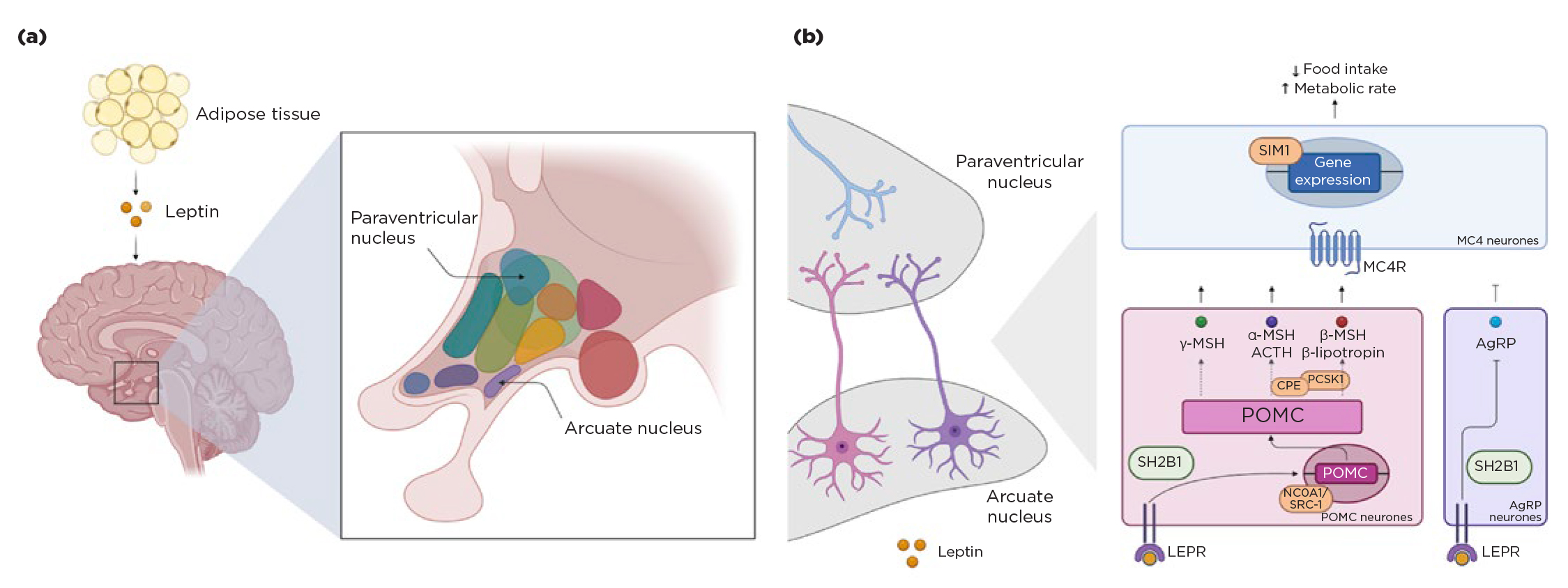
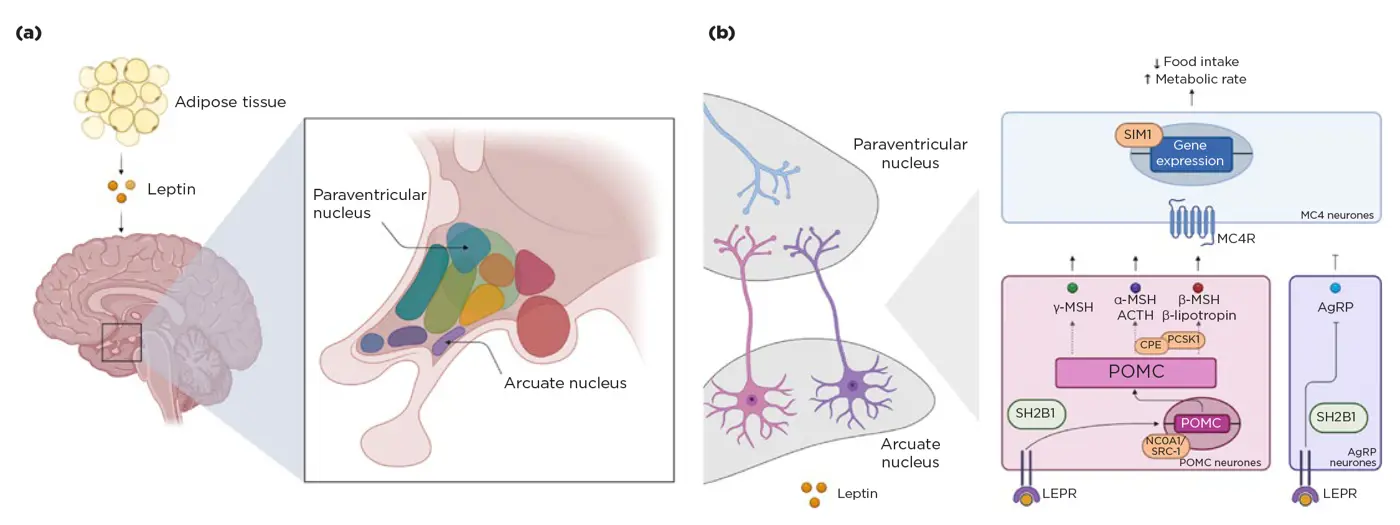
The Figure shows how this pathway modulates food intake through leptin signalling in the arcuate nucleus of the hypothalamus. Leptin activates neurones that express pro-opiomelanocortin C (POMC), which project to regions such as the paraventricular nucleus to promote melanocortin peptide release and suppress feeding. Leptin also inhibits neurones that express Agouti-related peptide (AgRP), removing an antagonistic signal and reinforcing satiety.1
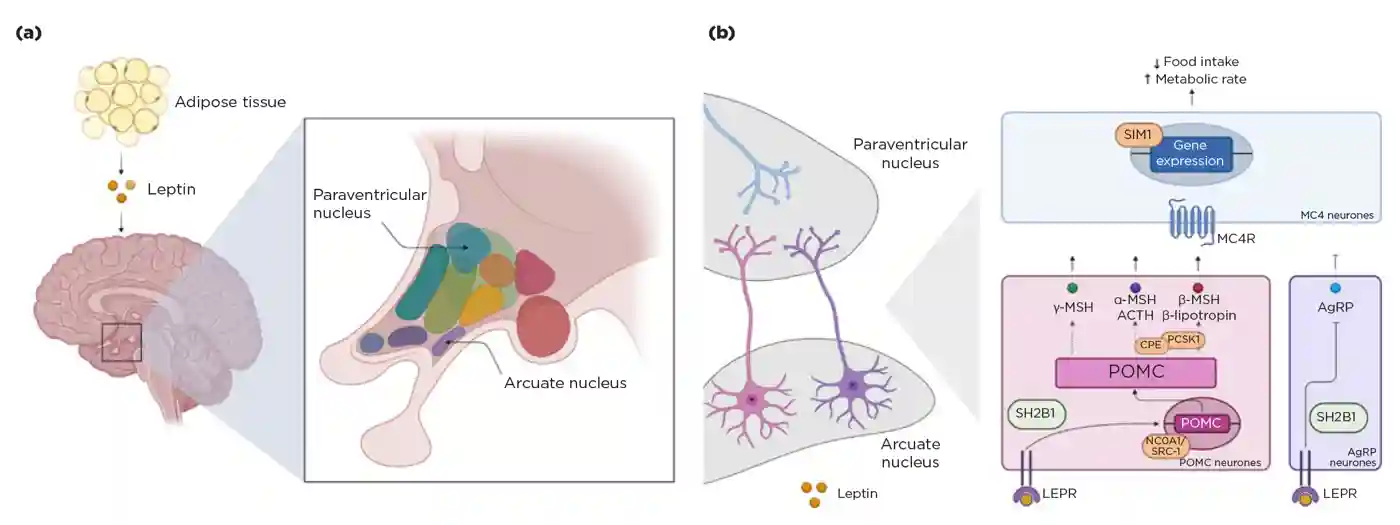
The hypothalamic leptin–melanocortin pathway. (a) Leptin and the hypothalamic nuclei. Leptin is produced by adipose tissue and acts on hypothalamic nuclei, such as the arcuate nucleus.1 (b) A simplified summary of the leptin–melanocortin pathway.10 ACTH, adrenocorticotrophin; LEPR, leptin receptor; MC4R, melanocortin 4 receptor; MSH, melanocyte-stimulating hormone. Created with BioRender.com.
One potential regulator of this pathway’s development is semaphorin (SEMA)–plexin (PLXN) signalling. SEMAs are extracellular signalling proteins that bind PLXN receptors to regulate axon extension and synapse formation.2 They are fundamental in directing axons to their precise targets during nervous system development and maintaining circuit integrity.3 Recent research has also shown that one subgroup of receptors, PLXNA, is required for functional satiety circuit development, and disruption of their signalling predisposes to obesity.4 This receptor family therefore emerged as a particularly interesting candidate for further study.
OBESITY AND PSYCHIATRIC DISORDERS: SHARED BIOLOGY?
Obesity commonly coexists with psychiatric disorders, independent of socioeconomic status or other risk factors.5 Genome-wide association studies suggest that this comorbidity reflects, in part, shared genetic overlap rather than purely behavioural or social factors.6 Notably, the PLXNA family has been implicated in psychiatric disorders, extending its influence beyond metabolic regulation.7 Given that neuronal loss has been linked to psychiatric illness, impaired neurogenesis resulting from PLXNA dysfunction could contribute to neuropsychiatric behavioural phenotypes.8
In keeping with this, a recent preprint from the Minchin lab at the Institute for Neuroscience and Cardiovascular Research reported that loss-of-function variants in PLXNA4 were not only associated with body mass index and height, but also a broad range of traits including worry, bipolar disorder, cognitive function and schizophrenia. Indeed, 61% of genome-wide significant associations at the PLXNA4 locus related to neurological, cognitive or psychiatric traits, suggesting a broader neuropsychiatric role.9
In light of these findings, PLXNA4 became the focus of my undergraduate dissertation within the University of Edinburgh’s MBChB programme, embedded within the wider programme of work in the Minchin lab. My project aimed to explore PLXNA4 as a candidate link between obesity genetics and the neuropsychiatric behaviours that characterise psychiatric disorders.
THE ZEBRAFISH MODEL
Larval zebrafish offer a useful in vivo system for investigating this relationship. They are genetically tractable and enable rapid CRISPR-based disruption of candidate genes.4 They are also a biologically relevant model of obesity; the Minchin lab has shown that loss-of-function plxna4 zebrafish mutants are shorter than wild-type fish and have excess fat accumulation relative to body size. High-resolution imaging suggested that this reflected hypertrophic subcutaneous adipose tissue, mirroring human obesity.9
‘One of the most valuable aspects of working in this area was gaining exposure to the breadth of approaches used to investigate obesity biology and behaviour.’
They have also identified notable behavioural changes. Compared to wild-type fish, plxna4 mutants consumed more food over a 10-minute period, indicating hyperphagia. Furthermore, when behavioural responses to food were examined, mutants showed greater activity, characterised by higher speed, greater speed variability, and more frequent high-speed burst events. Together, these findings highlight that PLXNA4 may alter both adiposity and behavioural regulation.9
REFLECTIONS
One of the most valuable aspects of working in this area was gaining exposure to the breadth of approaches used to investigate obesity biology and behaviour. These included human genetic analysis, CRISPR-based zebrafish models and behavioural phenotyping. As part of my project, I gained experience developing locomotion assays using the Zantiks program, which allows real-time video recording and automated tracking of individual zebrafish movement. This offered a scalable and quantitative method of assessing behaviour relevant to psychiatric disorders in zebrafish, providing a useful framework for linking genotype to behaviour.
I was delighted to receive the Emerging Researcher Prize and grateful for the opportunity to discuss my dissertation at the SfE BES conference 2026. Presenting was particularly valuable, both in sharing this area of research and in hearing about the breadth of work taking place across the field. As a year 4 medical student at an early stage in my career, I found it especially inspiring to meet both established and emerging researchers.
The experience strengthened my ambition to incorporate research into my future clinical practice and reinforced the importance of early-career clinicians engaging with academic medicine. I am especially appreciative of the Minchin lab, whose ongoing work provided the conceptual and experimental framework for my project, and whose support and guidance were invaluable throughout my time in the lab and beyond.
MADELEINE COWIE
Year 4 Medical Student, Institute for Neuroscience and Cardiovascular Research, University of Edinburgh
REFERENCES
1. Loos R & Yeo G 2021 Nature Reviews Genetics https://doi.org/10.1038/s41576-021-00414-z.
2. Carulli D et al. 2021 Frontiers in Synaptic Neuroscience https://doi.org/10.3389/fnsyn.2021.672891.
3. Koncina E et al. 2013 Landes Bioscience https://doi.org/10.1007/978-0-387-76715-4_4.
4. van der Klaauw AA et al. 2019 Cell https://doi.org/10.1016/j.cell.2018.12.009.
5. Lindberg L et al. 2020 BMC Medicine https://doi.org/10.1186/s12916-020-1498-z.
6. Ding H et al. 2022 Journal of Psychosomatic Research https://doi.org/10.1016/j.jpsychores.2022.111032.
7. Hill AS et al. 2015 Neuropsychopharmacology https://doi.org/10.1038/npp.2015.85.
8. Duman R 2009 Neurotoxicity and Neuroprotection https://doi.org/10.31887/dcns.2009.11.3/rsduman.
9. Tandon P et al. 2025 bioRxiv https://doi.org/10.1101/2025.03.15.643290.
10. Yeo G et al. 2021 Molecular Metabolism https://doi.org/10.1016/j.molmet.2021.101206.