Former General Secretary Karen Chapman reminds us how the Society keeps developing to reflect and serve our members.
My first Society for Endocrinology talk was at the November meeting (when there was a Society meeting in the autumn and SfE BES in spring) in 1992. That’s 34 years ago, when the Society was a mere youngster at just 46 years old.
I was pregnant with my first child at the time, so I was wearing a maternity dress. I remember being struck by the predominance of attendees wearing blue blazers with gold buttons, which I (jokingly) took to be the endocrinologists’ uniform. There are far fewer blue blazers in evidence nowadays at the SfE BES conference or, indeed, at any of the Society’s other events. This is one of the more trivial changes I have seen in my association with the Society over more than three decades.
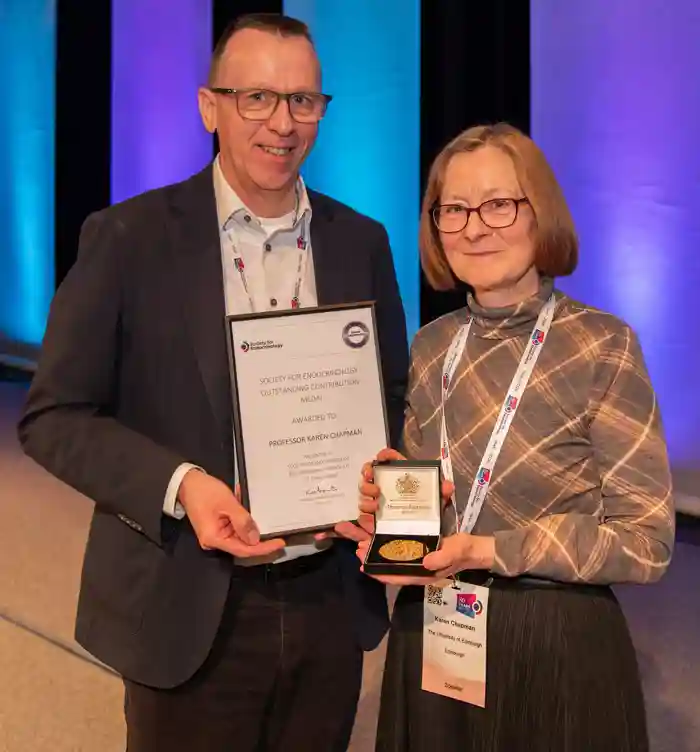
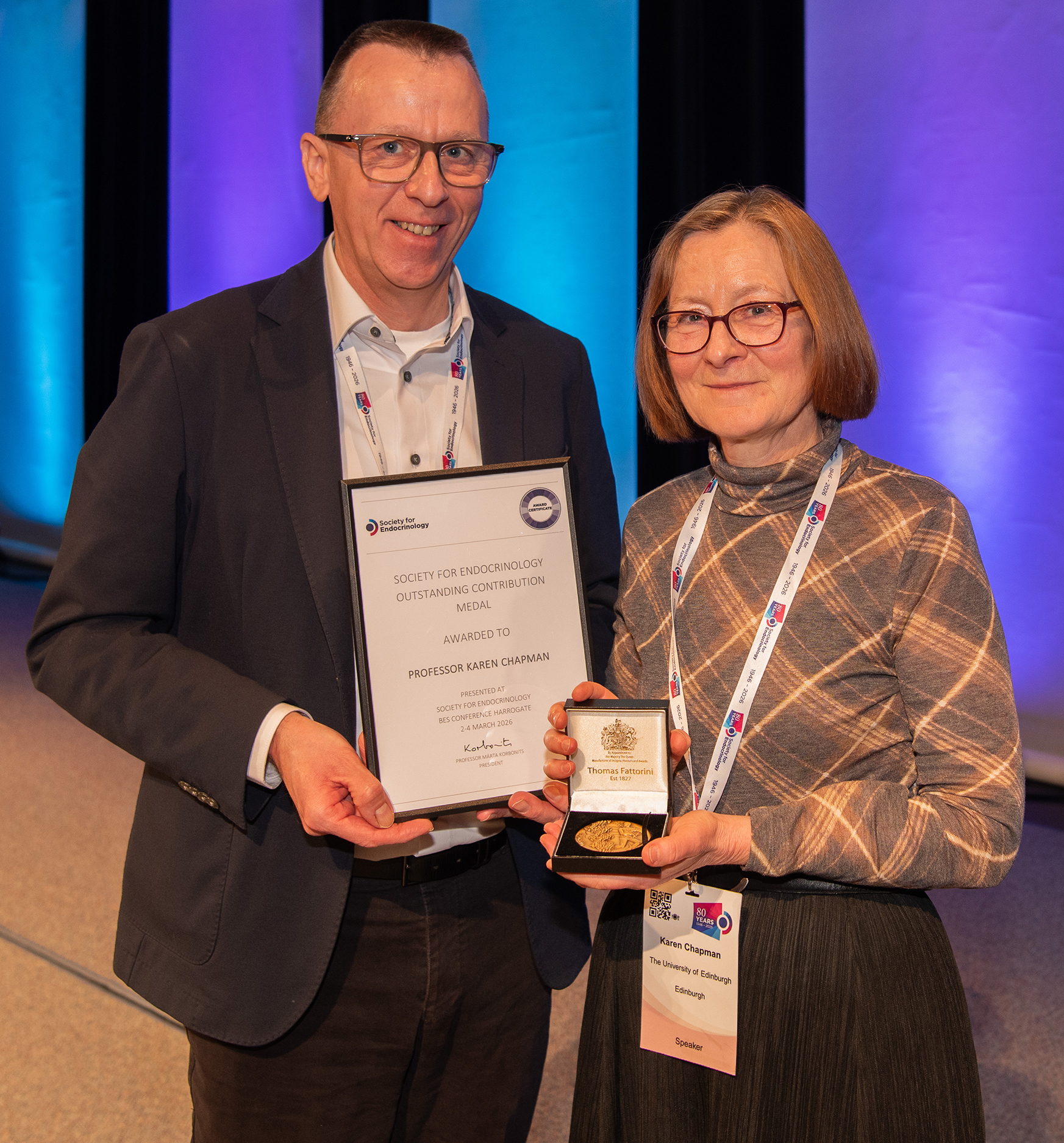
Karen receiving her Outstanding Contribution Medal at SfE BES 2026.
The Society for Endocrinology has long been my professional ‘family’. I first encountered it via the Hormone Group, which was then a joint committee between the Society and the Biochemical Society. I later switched my allegiance from the Biochemical Society to the Society for Endocrinology, and have been privileged over the years to play a part in its activities through serving on various bodies, including Council, the Science Committee (three times!), the Programme Organising Committee and the Publications Committee. I was privileged to be General Secretary from 2015 to 2018.
I was part of a working group that led to the merger of the Editorial Boards of the flagship journals, Journal of Endocrinology and Journal of Molecular Endocrinology. The merger ensured that both journals continued to thrive, generating income that underpins much of what the Society continues to do.
UNDERSTANDING OUR MEMBERS
More recently, I was honoured to lead the 2020–2021 Governance Review of the Society. This was a wonderful opportunity to learn who and what the Society is. The Governance Review was also an excellent vehicle for the Society to find out what its members wanted from it.
One of the outcomes has been a greater focus on the needs of all of the membership, which contrasts with the previous perception that the Society primarily catered to a small group within the membership. Greater transparency, more reporting back to the membership and open calls to the membership for vacancies on committees and on Council have greatly increased the breadth of experience on these bodies.
INCREASING DIVERSITY
The increase in diversity is probably the most obvious change I have seen over 30 years. It took more than 60 years for the Society to elect its first female President, Dame Julia Buckingham, who was in the role from 2009 to 2012. It was another decade before the Society elected its second female President, Márta Korbonits, in 2022. Remarkably, in March 2026, Márta handed the baton to the third female President, Kristien Boelaert.
'Over the last decade, the nurse group has grown and thrived, and has offered a few lessons to the rest of us in how to innovate, particularly with online training.'
I remember being quite intimidated when I first attended a Council meeting. Council is much more diverse and welcoming now, with more in the way of induction and management of expectations. Now, committees are more likely to include clinicians from district general hospitals as well as scientists working in universities without an associated medical school.
Although nurse members have long been active in the Society, for many years they had little recognition within the organisation and no formal seat on Council. Over the last decade, the nurse group has grown and thrived, and has offered a few lessons to the rest of us in how to innovate, particularly with online training. They are now formally represented on Council and have their own dedicated award, in recognition of excellence in endocrine nursing.
TRAINING AND CAREER SUPPORT
A greater diversity of training and career support is on offer, and to far more members than previously. The Society has moved away from its original provision of career support to perhaps just one or two individuals (through generous fellowships or grants), and now supports many more members through a variety of schemes, such as the Leadership and Development Awards Programme, mentoring, and career development workshops.
The rapid transition of events to be online, necessitated by the COVID-19 pandemic in 2020–2021, was an opportunity to open up new avenues for training and conferences, including to international members. Any of the regular membership newsletter emails from the Society will illustrate how successful that has been.
Some things, of course, never change. I don’t know when the tradition of holding the SfE BES in Harrogate started, and I don’t remember when I first visited Harrogate in spring for the conference, but I was certainly there in March this year. It was wonderful to catch up with my ‘family’ and to be reminded of how important some Society traditions remain.
KAREN CHAPMAN
2026 Outstanding Contribution Medallist