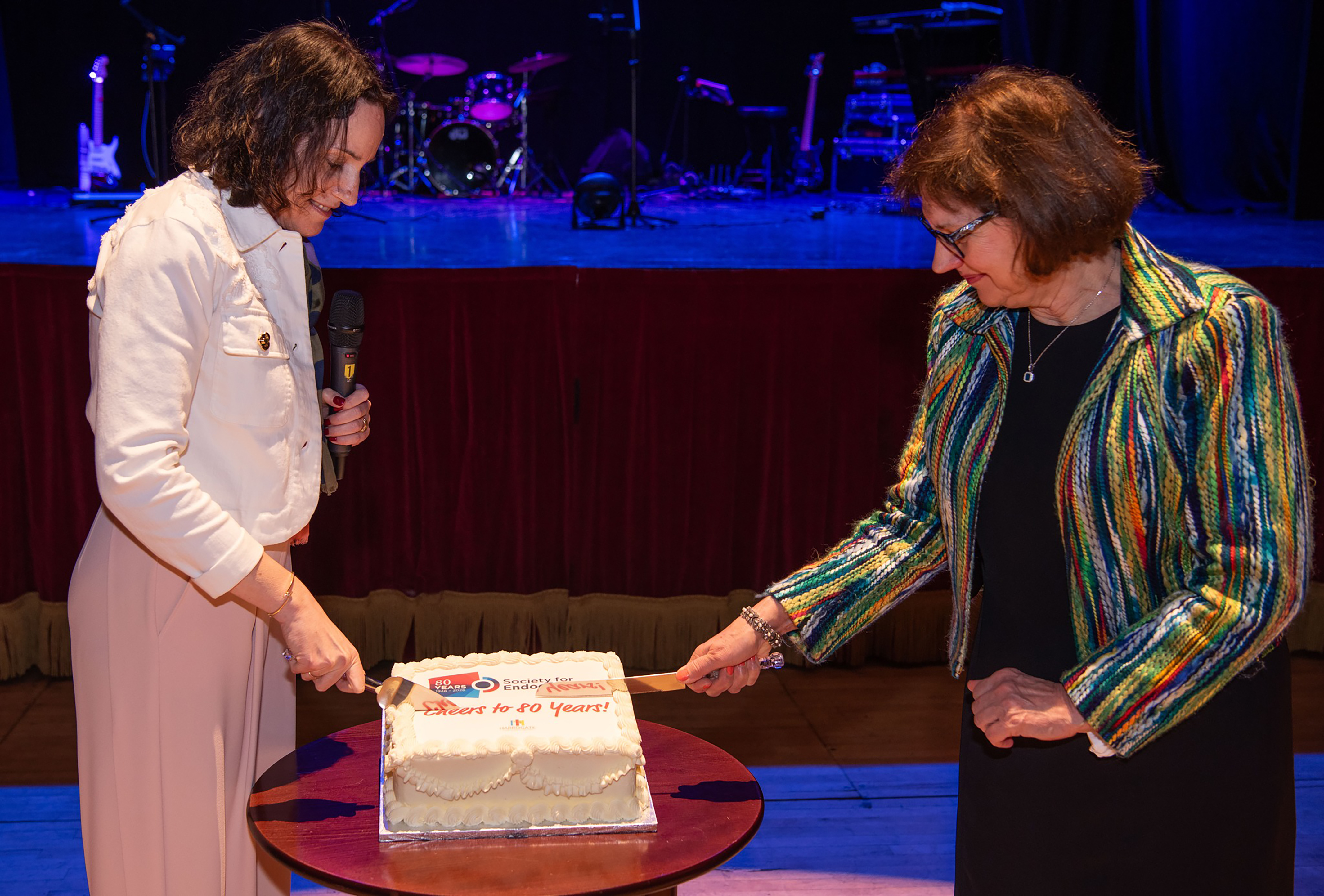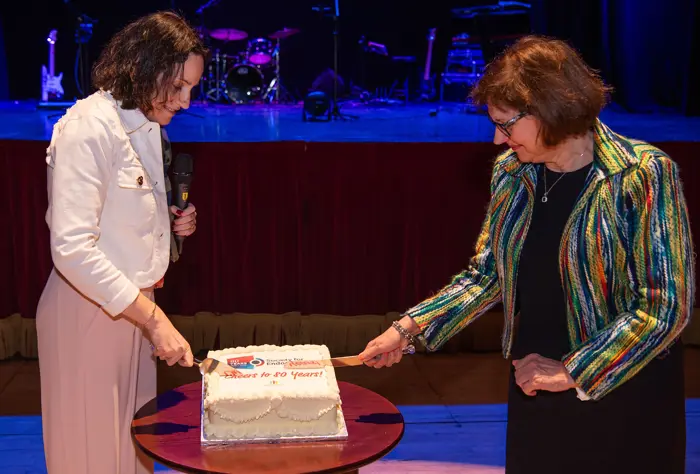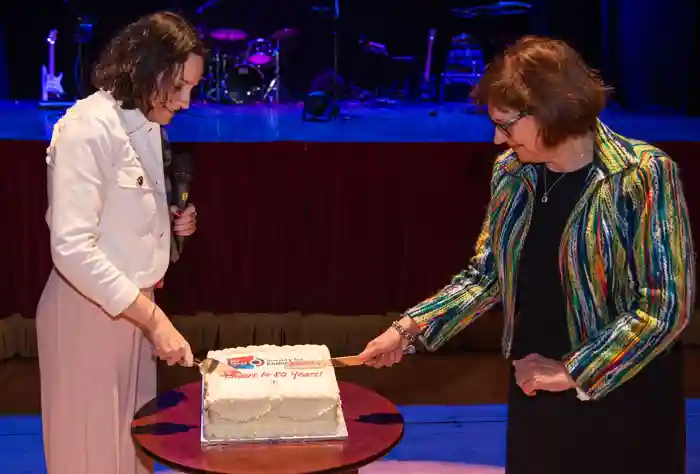
Márta (right) cutting the SfE 80th Anniversary cake with Kristien Boelaert.
I will always remember my first poster presentation at the 13th BES Meeting in Bournemouth in March 1994. Realising I was interested in all the posters, and wanting to catch all the talks, I happily darted from one room to another, puzzling at how I could listen to two talks at the same time. I felt excited, inspired, entertained and very much at home there – a feeling that has stayed with me ever since, at all the BES Meetings (now known as SfE BES conferences) over the last 32 years.
At the time, when I eagerly asked my supervisor (now mentor and friend) Ashley Grossman what he thought of the novel data in a talk, he sometimes replied he hadn’t in fact actually seen it, given that he spent most of his time in these meetings talking to people, rather than at the talks. I didn’t fully get it at the time, but I do now. Meeting people – from long-established leaders in a field to enthusiastic trainees at the beginning of their journeys – is one of the most rewarding aspects of our membership of the Society. Discussing data, new results, trends, ideas or simply good old gossip is what brings us together, and we are grateful to the Society for providing an ample forum for that. Equally meaningful has been our engagement with patient associations, whose insights remind us daily that our work has real and lasting impact on people’s lives.
Our annual meetings were indeed a highlight of my presidency, which I began in November 2022. From the vibrant gatherings in Glasgow and the inspiring joint meeting in Belfast with our Irish Society colleagues to the well-known and well-loved Harrogate events, each meeting embodied the spirit of endocrinology at its finest: open exchange, collaboration and shared curiosity. These meetings reaffirmed how vital our community is: not only for scientific progress but for the friendships and mentorships that sustain it.
My outstanding predecessor as President, Raj Thakker, introduced the Presidential Lectures, inviting outstanding scientists from a wider field. During my term, we welcomed Mark Caulfield, whose work on genomic medicine and data-driven healthcare highlighted emerging clinical applications; Sarah Teichmann, who explored cellular networks and systems biology; and György Buzsáki, whose research on neural circuits offered insights into memory and neuroendocrine regulation. Each brought a valuable external perspective to endocrinology.
'As I look back on my three and a half years as President of the Society for Endocrinology, I hope I contributed in some small way to providing the supporting and nurturing environment to other colleagues that I so enjoyed and benefited from over the years.'
Over the last three years, the Society has undergone significant transitions. Following the Governance Review led superbly by Karen Chapman, we introduced several notable changes. Amongst the most important of these is how the Society’s membership, leadership positions and awards are distributed. Individuals can now apply for opportunities directly themselves (in addition to being suggested by a proposer) and equal access to each role and award provides a wider reach and more leadership opportunities for everybody. We also restructured the grants portfolio and established a new Grants Committee to improve how funding is allocated. A review of awards and prizes, led by former President Julia Buckingham, resulted in updated criteria to recognise excellence across a broader range of members at more varied career stages.
In 2023 we introduced the Society’s first formal strategy establishing our vision, mission and four key goals. Following external changes, we moved the SfE BES conference back to the more suitable March period. As part of the governance changes – to be more robust and reflective of a modern Society and to better match our financial reporting – the Annual General Meeting is becoming a virtual meeting from September 2026: I hope to see you there on 16 September at 13.00–14.00.
We certainly did not lack challenges during my presidency. Although the pandemic was over, a change in the Chief Executive and global financial turbulence tested our stability and adaptability. I am immensely proud of how we faced these challenges together, turning a budgetary crisis into an opportunity for renewal, transparency and long-term improvement.
The resilience, professionalism and dedication of our staff were instrumental in navigating this period, and I remain profoundly grateful for their commitment. I would especially like to thank my colleagues in the executive team: Mark Gurnell as Finance Officer, Ruth Andrew and Aled Rees in the role of General Secretary, and Rob Semple and Kevin Murphy as Programme Secretary. My gratitude also goes to the Society Leadership Team, Laura Udakis, Jessica Davies, Laura Dudley, Alex Renahan and David Mills, and all their colleagues, for their continued dedication. Their work behind the scenes ensures everything runs smoothly. A key partner for the President is the Chief Executive. Following the hard work of Ian Russell, I had the good fortune to work with Kate Sargent, whose leadership steered the Society out of these challenging times. I am extremely grateful to her for this and wish her all the success she deserves as our CEO.
As I look back on my three and a half years as President of the Society for Endocrinology, I hope I contributed in some small way to providing the supporting and nurturing environment to other colleagues that I so enjoyed and benefited from over the years. I am filled with a deep sense of pride and gratitude that I was given the privilege to serve this outstanding community at such a dynamic and, at times, challenging period in its 80-year history. As I pass the baton to the very capable hands of Kristien Boelaert, I do so with confidence in the Society’s future and immense appreciation for every member who contributes to its mission.
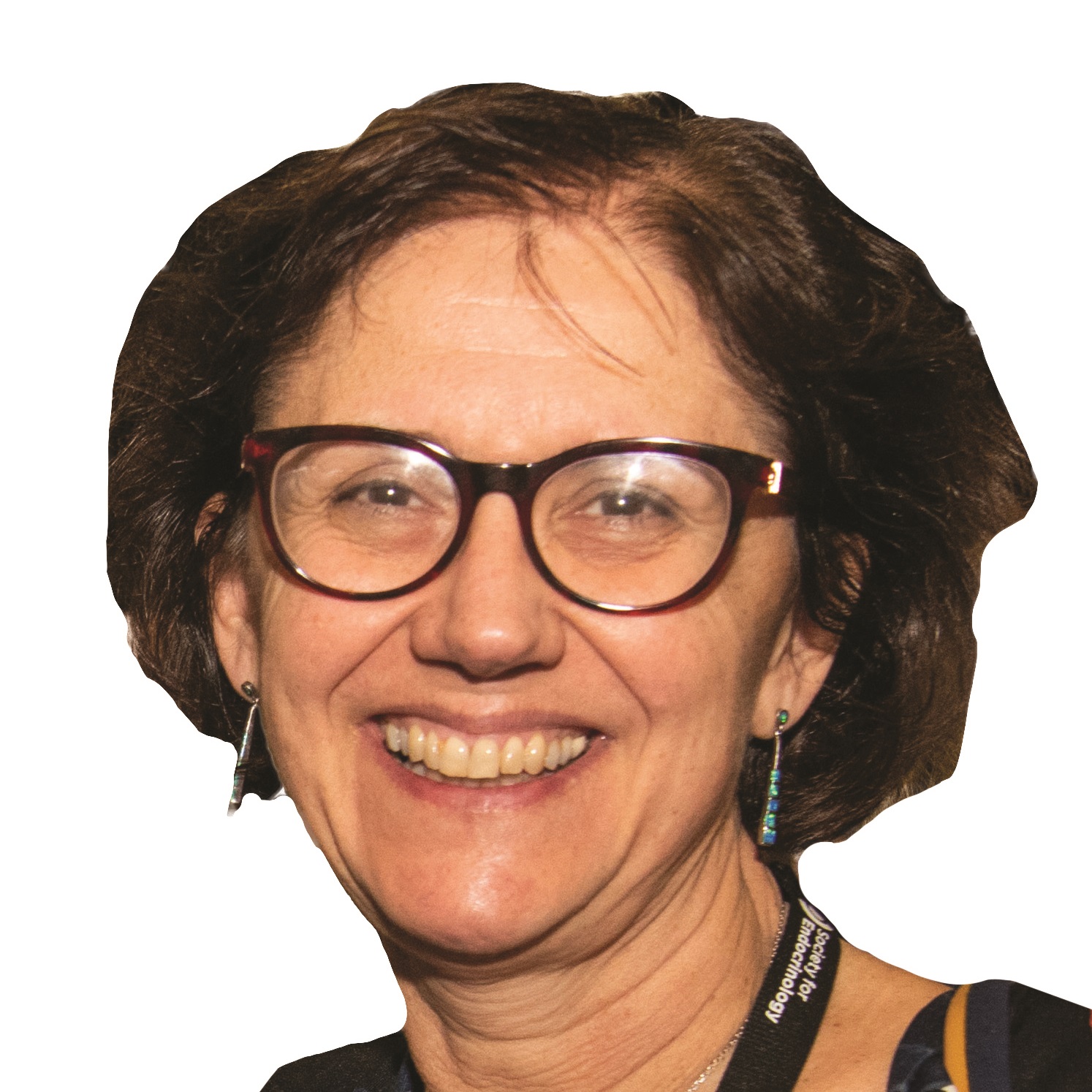
MARTA KORBONITS
Society for Endocrinology President 2022–2026