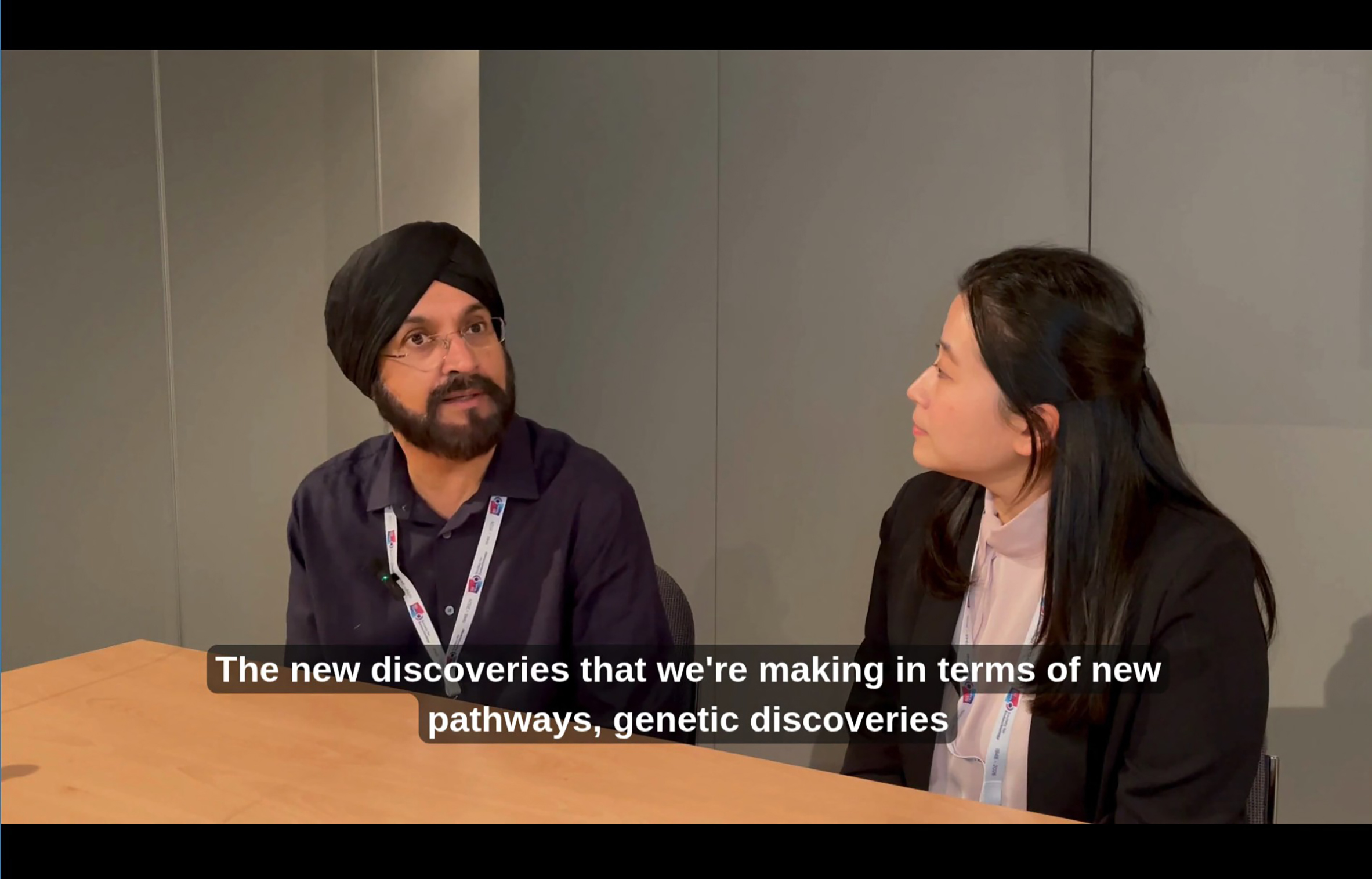
As part of the Society’s 80th anniversary celebrations, we caught a conversation at this year’s SfE BES between Professor Waljit Dhillo and Dr Kanyada Koysombat, both from Imperial College London. Waljit is a Professor in Endocrinology and Metabolism, Consultant Endocrinologist and an NIHR Senior Investigator. Kanyada is a Clinical Research Fellow in the Department of Metabolism, Digestion and Reproduction – Faculty of Medicine.
Watch their full conversation here
Kanyada: What drew you to the field of endocrinology?
Waljit: I trained at St Bartholomew’s Hospital, a very specialist endocrine centre. As an undergraduate, I encountered people like Mike Besser, John Wass, Ashley Grossman. Early exposure to endocrinologists naturally led me to the subject. What about you?
Kanyada: There was very good teaching in endocrinology at Imperial, and it was instilled into us how interesting the field is from the start of medical school. I was fascinated by the intricate balance between hormones, the feedback loops and the activation of hormonal cascades.
What have you found to be the biggest challenges?
Waljit: Google and phones have caused patient expectations and knowledge to go up. We’re getting more and more referrals, and there’s a need to screen out people who should be seen in secondary care and get early diagnosis and treatment. There’s also a lot of misinformation out there and some of the symptoms are quite non-specific. A lot of patients say they’ve got all the symptoms, but their hormone levels are normal. I think that’s a challenge.
Kanyada: What do you think have been the greatest positive changes?
Waljit (left) and Kanyada in conversation at SfE BES 2026.
Waljit: The speed of new discoveries compared to when I started is impressive. For instance, 10% of patients with a condition called idiopathic hypogonadotrophic hypogonadism were supposed to have a genetic cause. It’s now called congenital hypogonadotrophic hypogonadism because we know it’s all genetic, and up to about 60% of patients now have a genetic diagnosis. This is really exciting in terms of the research that’s driving new innovation and discovery.
Kanyada: What is important for researchers/registrars just starting out?
Waljit: You need a research grounding and an understanding. We must maintain the scientific basis and rigour, so people have the skill set to make future discoveries.
Kanyada: And practise evidence-based medicine on the wards as well. Valuable data can be collected from colleagues in clinical medicine, supplemented by academic centres. I think the two complement each other.
Waljit: As we move forward, data will become more and more important, with artificial intelligence. If we can use data across centres in different patient groups, that will advance the field further.
Kanyada: How have you benefited from having mentors, and how can people find them?
Waljit: I think most research leaders have been inspired by mentors. Two people who have been instrumental in my career are Professor Karim Meeran, who still runs our training programme, and Professor Stephen Bloom, who was my PhD supervisor and is now an investigator in the department I lead: we’ve come full circle. As early-career researchers, put yourself forward and say, ‘I’m interested in this space’. Most people have benefited from mentoring and are happy to mentor the next generation. So go for it!
‘There’s a lot of misinformation out there… A lot of patients say they’ve got all the symptoms, but their hormone levels are normal. I think that’s a challenge.’
Kanyada: I’ve been lucky to have be mentored by yourself, Professor Meeran, Dr Ali Abbara and Professor Alexander Comninos. I agree mentors are indispensable in shaping how we develop as future aspiring leaders. Everyone’s always happy to have a chat, and SfE BES is a great arena for those discussions.
Waljit: How hard is it currently, as a potential leader early in your career, to find networking opportunities?
Kanyada: The Society provides good opportunities. You can mingle with new people at the poster sessions at SfE BES, and everyone is happy to talk. You can also get involved through public engagement, schools, or through ‘You and Your Hormones’, where we look at scientific content for the public. There are different interest groups; for example, I’m part of the Metabolism, Obesity and Diabetes Endocrine Network and there are other Endocrine Networks for different areas. What do you think are good forums to meet people?
Waljit: As your career progresses you need to find the best people to work with internationally. As you get more established, you realise most people in your area are happy to collaborate. Perhaps 20 years ago, you could just be in your lab and do your own thing, but now, to make breakthroughs that will change practice, it has to be a multidisciplinary, with several teams working together. This is more interesting – and fun!