There have been significant advancements in the field of endocrine nursing. The Society for Endocrinology and the Society’s Nurse Committee have played a key role in the growth and development of endocrine nursing in the UK, with a mutually beneficial relationship spanning four decades that has gone on to bear fruit.
GERMINATION
The 1990s marked the initial growth phase for endocrine specialist nursing. The demand for endocrine specialist nurses was in part driven by new roles in areas such as adult growth hormone deficiency, where nurses became involved in the education, training and monitoring of patients with this disease.
In 1997, the Society for Endocrinology supported the inception of the Nurse Sub-committee (now the Nurse Committee), under the leadership of Chair Mavis Harris. It consisted of a mixture of adult and paediatric nurses, alongside a representative from the Society’s Council. The primary aims were to enhance endocrine nurse education and advance the role of the endocrine specialist nurse. This led to the introduction of the annual Endocrine Nurse Training Course in 1998 (now Endocrine Nurse Update) and the first dedicated nurse session at the BES meeting in 1999.
SEEDLINGS
In 2000, The NHS Plan outlined ten key roles for nursing, which supported the role of the clinical nurse specialist, with nurse-led care and independent nurse prescribing. This further supported the development of nurse-led services within endocrinology.
During the first decade of the 21st century, the Nurse Committee went to great lengths to raise the profile of endocrine nurses through improved communication, training and access to funding. This was achieved by the launch of Endocrine Nursing News in 2002, updates in The Endocrinologist, the introduction of the Society’s Certificate for Endocrine Nursing in 2003, a nurse page on the Society website in 2004, and access for nurses to Society travel grants in 2006. The decade saw international endocrine nursing relationships strengthened and, to this day, they remain steadfast.
‘During the first decade of the 21st century, the Nurse Committee went to great lengths to raise the profile of endocrine nurses through improved communication, training and access to funding.’
SAPLINGS
The 2010s welcomed many notable firsts. In 2010, Dr Sofia Llahana was the first UK Endocrine Nurse Consultant. In 2011, the ‘nursing practice’ abstract category and award were launched at the SfE BES conference, recognising the valuable contribution of nurses within endocrinology. The Competency Framework for Adult Endocrine Nursing was first published in 2013, followed by the second edition in Endocrine Connections in 2015, under the leadership of former Nurse Committee Chair Nikki Kieffer. It remains a widely utilised and referenced tool in clinical practice, both nationally and internationally.
The establishment of the European Endocrine Nurse Committee (2013) and the Federation for International Nurses in Endocrinology (2014) created further opportunities for global collaboration. In 2016, the Endocrine Nurse Award was introduced to recognise excellence in endocrine nursing, with Nikki Kieffer the inaugural recipient. This was followed by the introduction of the Endocrine Nurse Grant, first awarded to Julie Lynch in 2018.
In 2019, the first endocrine nurse textbook was published, containing contributions from UK nurses, and entitled Advanced Practice in Endocrinology Nursing.
YOUNG TREES
In 2020, under the leadership of Anne Marland, the Oxford Brookes Masters-level module in endocrine nursing was introduced, replacing the Certificate for Endocrine Nursing. To date, 28 nurses have completed the module.
In 2021 the Endocrine Nurse Award was renamed the Nikki Kieffer Medal (pictured) in honour of Nikki’s significant contribution to endocrine nursing.
The benefits of endocrine nurse services were highlighted in two key publications. First, the GIRFT Programme National Specialty Report on Endocrinology (2021) showcased examples of effective nurse-led practice and highlighted the need for an increase in endocrine nurse provision in 76 out of 126 centres reviewed. Then, Defining the Future of Endocrinology (2022) emphasised the importance of structured training, career progression and mentorship for endocrine nurses.
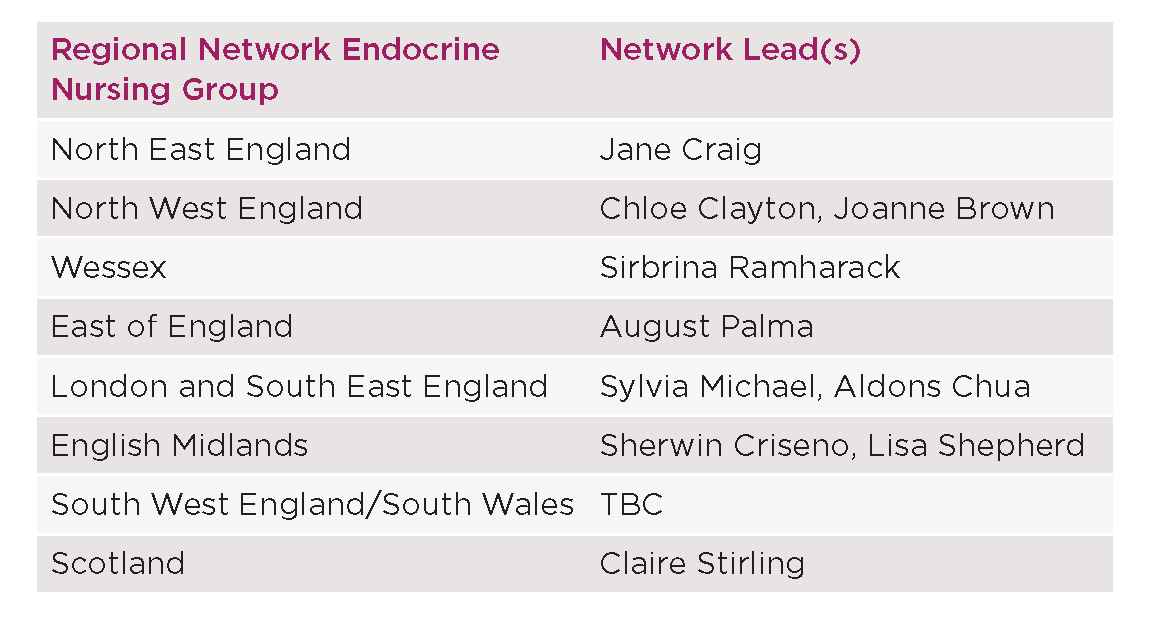
In response to these recommendations, the Society for Endocrinology supported the development of additional Regional Endocrine Nurse Networks in 2023 (see Table below), utilising the model of the Wessex group. Resources for endocrine nurses continued to expand, including the ‘Endocrine nursing practice’ section in the fourth edition of the Oxford Handbook of Endocrinology and Diabetes (2022).
In 2025, the Endocrine Nurse Newsletter was relaunched to provide endocrine nurse-specific communications. The third edition of the Competency Framework for Adult Endocrine Nursing and the Online Learning Platform were launched to further support mentorship, networking, training, education and career progression of endocrine nurses (see The Endocrinologist issue 159). The updated Competency Framework for Adult Endocrine Nursing included competencies for nursing support nurses working in endocrinology, leading to the formation of the Society for Endocrinology Nursing Support Workers Network.
‘Endocrine nurses have shared their clinical practice and research both nationally and internationally.'
In the last three years, there has been a significant increase in nurse representation within national/European guideline groups, as well as within the Society for Endocrinology. Achievements include Sherwin
Criseno being the first nurse elected as a Society Council trustee (2023), Cosmina Schiteanu becoming the first nurse on the Editorial Board of The Endocrinologist (2024), Aldons Chua being the first nurse recipient of a Leadership and Development Award (2024), and Dr Sofia Llahana’s appointment as the first Chair of the Society’s Corporate Liaison Committee (2025).
MATURITY
Endocrine nurses have shared their clinical practice and research both nationally and internationally. Supporting nurse-led research remains a priority for the Society for Endocrinology, alongside ongoing training and development of endocrine nurses at all stages of their career pathways. As the well-known proverb aptly states ‘great oaks from little acorns grow’, a sentiment that reflects the evolution and strength of endocrine nursing.
LOUISE BREEN
Past Chair, Society for Endocrinology Nurse Committee and Advanced Nurse Practitioner – Endocrine, Guy’s and St Thomas’ NHS Foundation Trust, London